Personal insights and calculation guides from the world of structural engineering directly in your inbox.
Welcome to the Steel Design Series (Ep. #01)
|
Happy Wednesday friends, Today, we’re kicking off a new series - the steel design series. The next weeks and months will be packed with structural engineering value. If you have been subscribed for a while, you know how much into detail we went in the reinforced concrete series and timber design series. All this knowledge that you'll be receiving in this newsletter will be free. Only if you want to access past episodes, you can do so with the 5€/month membership. Those of you who have been around for some time understand now how we structured the content of the last months and years. We have built up our knowledge of structural engineering fundamentals to be able to dive into structural design now.
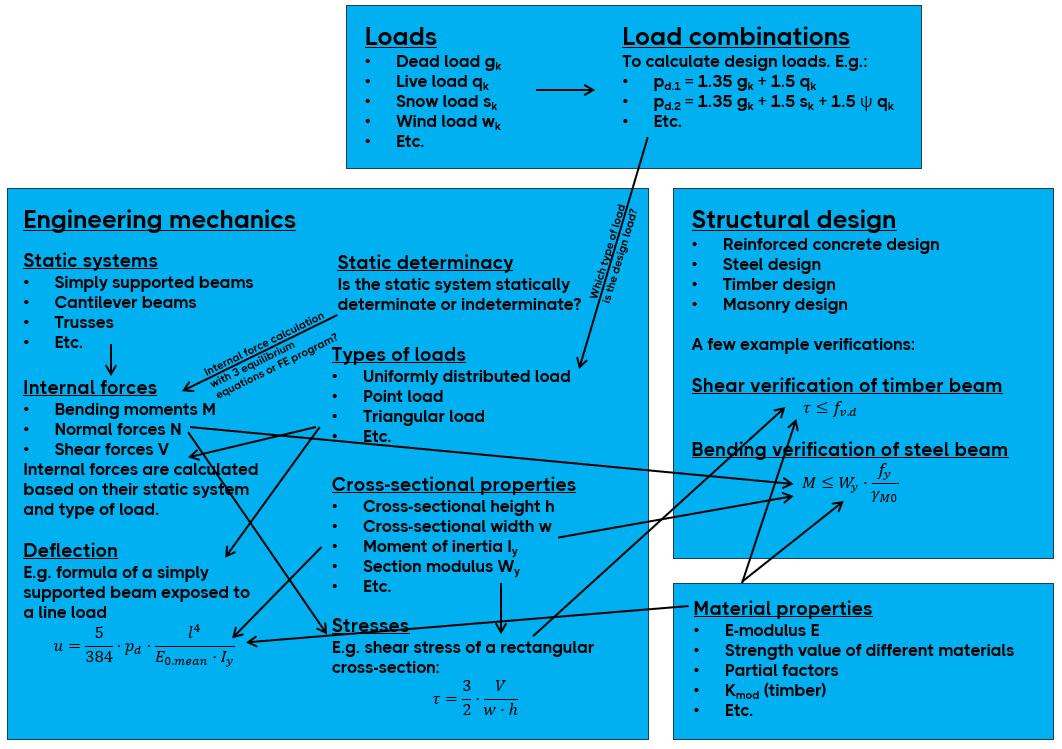
You can sign up here: https://structuralbasics.kit.com/products/exclusive-newsletter I started with the Engineering Mechanics Series and Structural Loads Series because they were important to have the necessary foundation (=fundamental engineering knowledge) to build a strong and stable building (=structural design). In my opinion, structural engineering verifications can be split up into 3 or 4 parts:
Without knowing how to calculate loads or which static system to use, you can’t design a reinforced concrete beam correctly. Introduction To What’s ComingThere will be alot of content, guys. I did a quick brainstorming session a few weeks back, writing down article topics, and the list is huge, again. Occasionally, we’ll be publishing content about other topics, as we have been doing. This could be a guest post, a personal story from our industry, an article about a cool tool or workflow I use. So here are a few topics we’ll be covering in this new series:
Once we have covered these verifications/”basics”, we’ll move on to design “real” structural elements. Design and verification of:
But the most challenging and in most cases most critical part of timber structures is the connection design. The connection verification often defines the cross-sectional dimensions.
You see, there are many topics that we need to cover, so you will be confident in steel design. And as we go, I’ll find new topics, which we’ll write about. Final WordsI am really excited about this new series, because structural design is the thing I enjoy the most about structural engineering. And seeing your design come to life is really rewarding. Our designs have an impact on other people’s life and our environment. If you want to catch up on engineering basics (which will definitely help you for the steel design series), I’ll recommend checking out our video tutorial on determinate and indeterminate structures. Short intro today, I’ll see you soon for episode #2. Cheers, Laurin. ↓ Follow me on Social Media. ↓ |
Structural Basics
Personal insights and calculation guides from the world of structural engineering directly in your inbox.
Hi friends, I just came back from vacation in California. My girlfriend and I visited her parents in Silicon Valley and then traveled around a bit. It was a great trip and my first time in the US. We visited San Fransicso (the Golden Gate bridge was a must-see), LA, Carmel by the Sea, Santa Barbara, Solvang, Malibu and many places in the bay area. As a structural engineer, I can’t switch off of course: I looked at plenty of construction sites and structures. Here is what stood out to me and...
Hello and happy Wednesday, Today, we’ll quickly introduce the steel properties we use to design steel elements like the compression strength, bending strength and partial safety factors. These material properties are the fundamentals of structural design. In this article, we’ll explain what properties are important, where we find them and how to calculate them (if needed). So, let’s get into it. The 7 Most Used Steel Properties Material properties of steel are really important for structural...

Hi friends, Back in 2016 when I started university, content creation wasn’t a thing. And there were definitely no structural engineers creating content online in text or video. Luckily, that has changed over the last 5 years and a few people from our industry were brave enough to share their knowledge publicly. And there is still room for more content creators and content. There's simply endless of content to create. I have content ideas for at least the next 5 years. Every building and...